
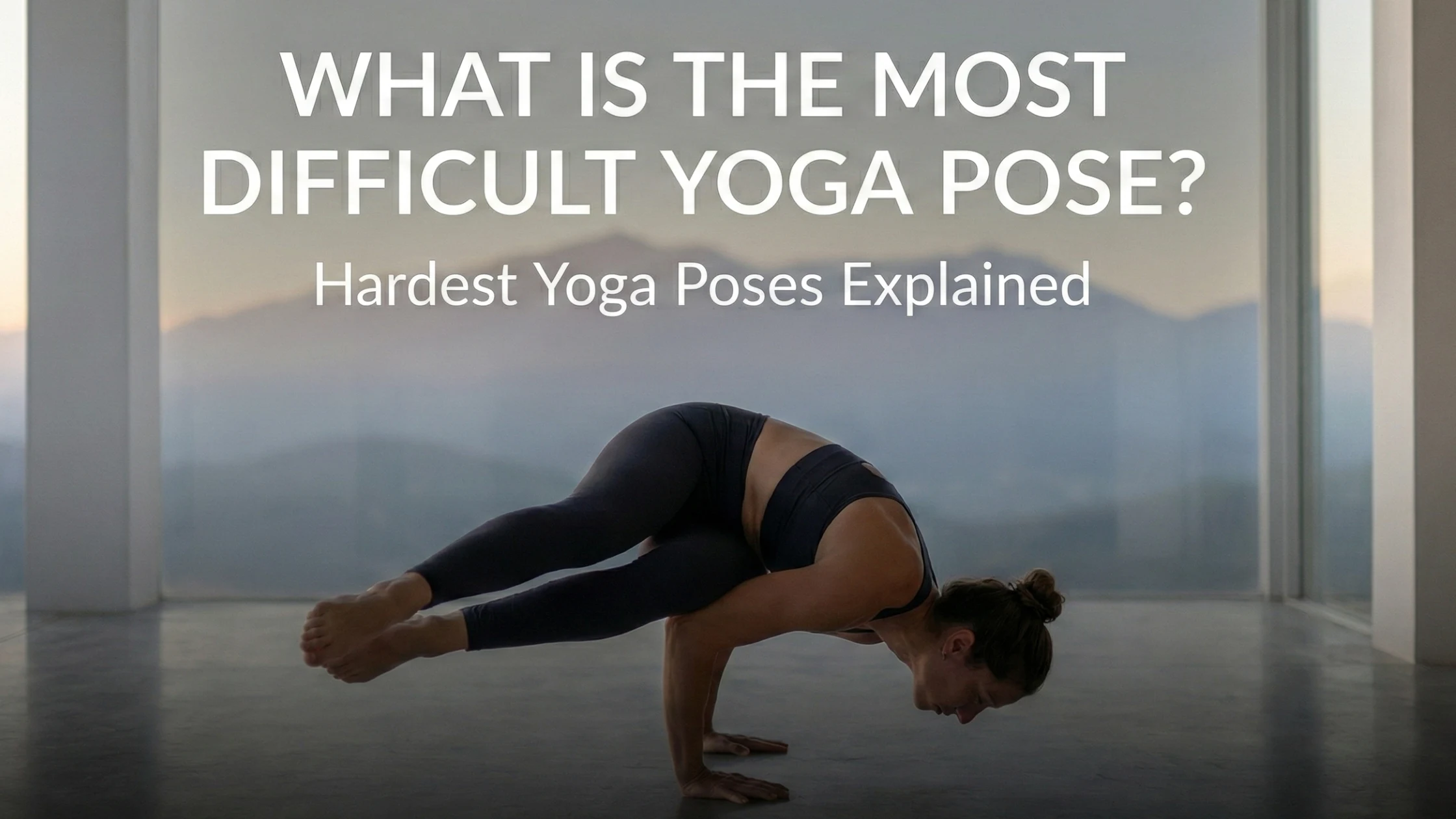
Yoga is often portrayed as a serene practice of gentle stretching and quiet meditation. However, for those who move beyond the basics, it reveals itself as a discipline of extreme physical and mental demand. From gravity-defying arm balances to deep backbends that seem to reshape the spine, the journey toward advanced asana is one of relentless dedication.
But what truly is the most difficult yoga pose? The answer isn’t as simple as a single name. Difficulty in yoga is subjective, depending on whether your personal challenge lies in raw strength, extreme flexibility, or the mental stillness required to remain motionless.
In this guide, we break down the hardest yoga poses in existence, the science of what makes them so challenging, and how you can safely progress toward these “peak” postures.
Table of Contents
What Makes a Yoga Pose “Difficult”?
Difficulty is a multifaceted concept in yoga. A pose that feels impossible to a bodybuilder might be effortless for a former gymnast, and vice versa. Generally, difficulty is measured by four primary factors:
1. Physical Strength (Functional Power)
Many advanced poses require “relative strength” the ability to move and stabilize your own body weight. Poses like Handstands or Peacock Pose demand immense power in the wrists, shoulders, and core. Without a solid foundation of functional strength, these poses aren’t just hard; they are high-risk.
2. Extreme Flexibility
Some postures require the body to move into shapes that seem to defy human anatomy. This isn’t just about “stretching”; it’s about active mobility. For example, the King Pigeon Pose requires deep openness in the hip flexors, quadriceps, and the entire front of the spine.
3. Proprioception and Balance
Inversions and arm balances flip your world upside down. When your feet leave the ground, your brain has to recalibrate its sense of where you are in space. Maintaining a One-Handed Tree Pose requires micro-adjustments in the hand and core that take years of neural conditioning to master.
4. Mental Stillness
Paradoxically, many masters consider Savasana (Corpse Pose) the most difficult pose. While physically passive, the mental requirement—total stillness of the mind and body for 10–20 minutes—is a feat that few modern practitioners truly achieve.
The Top Hardest Yoga Poses Explained
While everyone’s “Everest” is different, these postures are widely recognized in the global yoga community as the pinnacle of physical practice.
1. Taraksvasana (Handstand Scorpion)
If the Handstand is the “king” of inversions, the Handstand Scorpion is the emperor. It combines the extreme balance of a Handstand with the deep spinal flexibility of a Scorpion.
- The Challenge: You must maintain a vertical balance on your hands while simultaneously arching your back so deeply that your feet touch the crown of your head.
- Why it’s hard: It requires “blind balance,” as you can no longer see the floor once your head moves forward into the backbend.
2. Yoganidrasana (Yoga Sleep Pose)
Don’t let the name fool you – this is far from a nap. This pose involves lying on your back and tucking both legs behind your head, then crossing your arms behind your back to bind your hands.
- The Challenge: It requires “pretzel-like” hip flexibility and a very long, supple spine.
- Why it’s hard: The compression on the chest and abdomen makes breathing difficult, requiring the practitioner to find calm in a highly constricted state.
3. Eka Hasta Vrksasana (One-Handed Tree Pose)
This is a Handstand performed on only one arm, with the legs often held in a specific shape.
- The Challenge: Total weight distribution over a single wrist.
- Why it’s hard: It is the ultimate test of wrist strength and core stabilization. There is no room for error; the slightest shift in weight results in a fall.
4. Gandha Bherundasana (Formidable Face Pose)
This pose looks like something out of a circus act. It is a chin stand where the legs are brought over the head until the feet rest flat on the floor next to the face.
- The Challenge: Intense compression of the neck and upper spine.
- Why it’s hard: It requires a level of spinal mobility that most people simply do not possess, combined with enough arm strength to ensure the weight doesn’t collapse onto the throat.
5. Kala Bhairavasana (Destroyer of the Universe)
Named after a fierce manifestation of Shiva, this pose is a side plank performed with one leg tucked behind the head.
- The Challenge: It combines a deep hip opener, a balance, and a core-strengthening plank.
- Why it’s hard: Keeping the leg behind the head while balancing on one arm requires incredible “closing” strength in the hips and a fearless sense of balance.
Is Your Body Ready?
Yoga is a journey of levels. Attempting a “Level 5” pose with “Level 1” foundations is a recipe for injury. Here is how the progression typically looks:
| Level | Focus | Example Foundational Poses |
| Beginner | Alignment & Breath | Mountain Pose, Downward Dog, Cobra |
| Intermediate | Strength & Intro to Balance | Crow Pose, Headstand, Warrior III |
| Advanced | Combined Flexibility & Power | Handstand, Full Split (Hanumanasana) |
| Elite | Mastery of Inversions & Binds | Scorpion, One-Handed Arm Balances |
Important Note: “Advanced” yoga doesn’t mean “better” yoga. The goal of yoga is union of mind and body. A person in a perfect Savasana may be “deeper” in their practice than someone struggling through a handstand with a distracted mind.
Safety & Progression Tips
Mastering the most difficult yoga poses isn’t about “trying harder”; it’s about practicing smarter. Use these strategies to progress without compromising your joints.
1. Build a Solid Foundation
You cannot build a skyscraper on sand. Before attempting Scorpion Pose, you must be able to hold a Forearm Stand (Pincha Mayurasana) with total stability for at least 30–60 seconds.
2. Use Props Ruthlessly
Even elite yogis use blocks, straps, and walls.
- The Wall: Your best friend for inversions. It removes the fear of falling so you can focus on muscle engagement.
- Straps: Essential for “binding” poses where your hands don’t quite reach yet.
- Blocks: They “bring the floor to you,” allowing you to maintain proper spinal alignment in deep stretches.
3. Master the Breath (Pranayama)
The breath is the barometer of safety. If your breath is shallow, jagged, or held, your nervous system is in “fight or flight” mode. This causes muscles to tighten, increasing the risk of tears. If you can’t breathe deeply in a pose, you have gone too far.
4. Warm-Up for the Specific Goal
If you are working toward a deep backbend like Kapotasana (King Pigeon), a generic warm-up isn’t enough. You need “peak pose sequencing,” focusing specifically on opening the hip flexors, psoas, and thoracic spine before attempting the final shape.
5. Seek Professional Guidance
Videos are great, but they can’t see your alignment. A qualified instructor can spot “leaks” in your energy or misalignments in your joints (like “dumping” weight into the lower back) that could lead to long-term injury.
Conclusion
The journey of yoga is inherently personal and non-competitive. It is essential to respect your body’s limits on any given day, listening to the subtle signals of resistance or openness. Celebrate the small victories-the extra second you held a balance, the deeper range of motion in a stretch, or the moment you found stillness in your mind. These small triumphs build the foundation for greater achievements.
Always hold onto the encouraging perspective that today’s pose which seems utterly “impossible” or out of reach, is merely tomorrow’s essential warm-up, provided you approach your practice with enough patience and unwavering consistency. The practice itself is the destination.
The quest for the most difficult yoga pose is definitely a fun physical challenge, but the real “advanced” practice? It’s the simple one that gets you back on the mat every single day. Seriously, whether you’re nailing a headstand or just sitting in a chair focusing on your breath, the core benefits of yoga-that lovely sense of clarity, strength, and inner peace-are exactly the same.
Just remember to listen to your body, celebrate those little wins, and trust me: that “impossible” pose today will be your easy warm-up tomorrow, as long as you stick with it.