So, you’ve conquered the Downward-Facing Dog, you finally understand where your ‘sit bones’ are, and now you’re able to finish a 60-minute class without counting off five minutes on your watch every five minutes.
First of all, Congratulations! Becoming a regular yoga practitioner from a complete beginner is an achievement in itself.
But now, you’re looking at the studio schedule or surfing around on your phone, and there it is: Level 2 / Intermediate Flow.
A small pit of anxiety develops in your stomach. Are you ready? Are you going to be the only one in the room who can’t perform a headstand? Are you going to face-plant in Crow Pose?
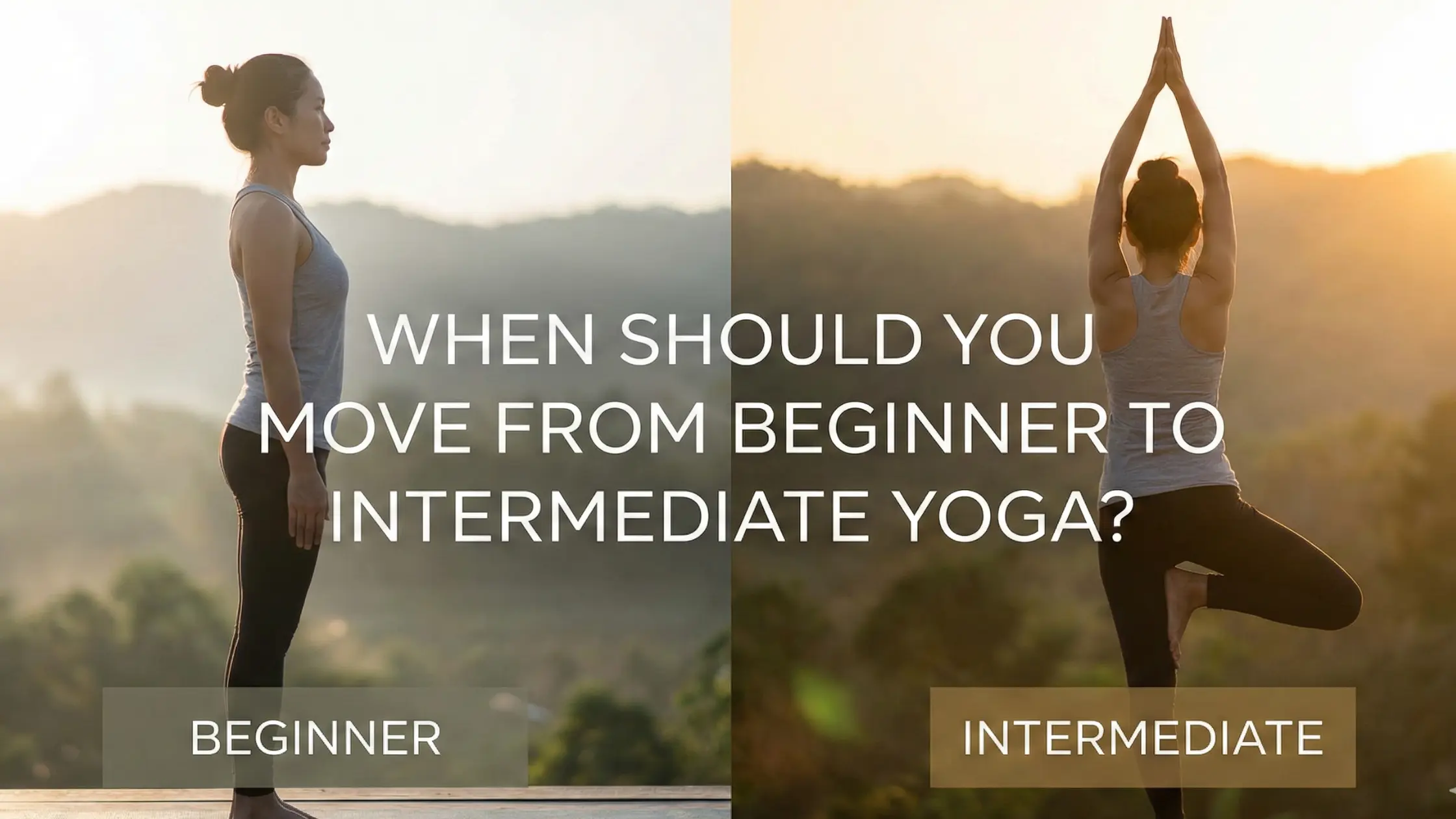
Knowing when to transition from a beginner to an intermediate level of yoga isn’t about a date on the calendar – it’s about the transition in your body, your breath, and your mind. Let’s get into the details of how to recognize the milestones to take your yoga to the next level.
Mastering the Language of Flow
In a beginner class, the teacher spends a lot of time explaining where your feet go and how to stack your joints. In an intermediate class, the “how-to” talk drops away, and the pace picks up.
1. “Prop Intuition”
A common misconception is that intermediate yogis don’t use props. In reality, they use them better. You’re ready to move up when you no longer wait for the teacher to say, “Grab a block.” You already know that your hamstrings feel tight today, so you’ve placed the block at the top of your mat before the flow even begins. You understand how to use a strap to bridge the gap in Cow Face Pose without compromising your spine.
2. Muscle Memory and Terminology
You no longer need to crane your neck to look at the teacher (or your neighbor) every time a pose is called out. When you hear “Warrior II,” your back foot automatically pivots to 90 degrees, your arms reach out with intention, and your gaze settles over your front middle finger. This muscle memory is vital because intermediate classes often feature “complex transitions”- moving quickly from one shape to another without a break.
3. Awareness of Alignment
You’ve moved past just “doing” the pose and started “feeling” the pose. You know if your knee is caving inward in a lunge, and you know how to fix it yourself. This self-correction is the hallmark of an intermediate student; you are becoming your own best teacher.
Also read: Yoga Before or After Running: What’s Better for Your Performance?
Strength & Flexibility Benchmarks
Intermediate yoga introduces “peak poses” like arm balances and inversions. These aren’t just for show – they require a baseline of functional strength and mobility that takes time to build.
1. The Chaturanga Test
The “Yogi Push-up” (Chaturanga) is the most repeated movement in Vinyasa yoga. You are ready for intermediate classes when you can lower from a high plank to a low plank with total control. If your elbows flare out like a standard push-up, or if your hips “snoop” (sag) toward the floor, you need more time building core and tricep strength. An intermediate flow might include 20+ Chaturangas; you need to be able to do them safely to protect your shoulders.
2. The “Holding” Capacity
Beginner classes often move through poses quickly to keep things interesting. Intermediate classes might ask you to hold a Chair Pose or a Crescent Lunge for a full minute. If you can maintain the integrity of your posture – keeping your core engaged and your breath steady even when your muscles begin to shake – your nervous system is ready for the higher demands of Level 2.
3. Functional Flexibility
You don’t need to be able to put your foot behind your head. However, you should have enough “functional” flexibility that your breath isn’t restricted. For example, if you can keep a relatively straight spine in Downward Dog without your heels being miles off the ground, or if you can step your foot forward between your hands from a three-legged dog in one smooth motion, your joints have the necessary range for faster flows.
Also read: The Smart Way to Snack: Why 100-Calorie Snacks Make Healthy Eating Easier
Mental Readiness
This is the most overlooked part of knowing when to move from beginner to intermediate yoga. In the beginning, yoga is a physical struggle. As you progress, it becomes a moving meditation.
1. Breath as the Primary Driver
In a beginner class, you’re often just trying to remember to breathe at all. You’re ready for the next level when your breath leads the movement. This is called Vinyasa (breath-synchronized movement). If you can match every inhale to an opening and every exhale to a closing or a fold throughout a sequence, you have mastered the most difficult part of yoga.
2. The Death of the Ego
The “Intermediate” label can be a trap for the ego. A true intermediate practitioner is someone who has the confidence to drop into Child’s Pose even if the rest of the class is doing a handstand. If you feel pressured to “keep up” or “look cool,” you are still in a beginner mindset. Mental readiness means knowing your limits and choosing the version of the pose that serves your body today, not the version that looks best on Instagram.
Also read: How to choose a perfect Yoga Mat?
Common Mistakes When Leveling Up
Moving up too early (or for the wrong reasons) can lead to injury or “Yoga Burnout.” Watch out for these red flags:
- Chasing “Fancy” Poses: Many students jump to intermediate classes because they want to learn Crow Pose or Headstand. But if you try these without the foundational core strength, you risk straining your neck or wrists.
- Neglecting the Basics: “Advanced” yoga is really just the “Basics” performed with 100% mastery. If your Mountain Pose (standing still) is lazy, your Handstand will be unstable.
- Ignoring Pain: A common mistake is thinking that “intermediate” means “pushing through the pain.” In yoga, pain is a stop sign. If you find yourself gritting your teeth to stay in a pose, you’ve gone too far.
Also read: Acid Reflux-Friendly Fish Chowder Recipe
The “Bridge” Method
If you’re still on the fence, you don’t have to make a permanent switch today. Use these strategies to test the waters:
- Attend “All Levels” Classes: These are the perfect training ground. The teacher will offer a “base” pose (Level 1) and then offer “evolutions” (Level 2). See how many of the evolutions you can take while keeping your breath steady.
- Try an Intermediate Video at Home: Use an online platform to try a 30-minute intermediate flow. This allows you to pause the video, re-watch a transition, and “fail” in the privacy of your living room without feeling self-conscious.
- Ask for a “Form Check”: After your usual beginner class, ask the instructor, “I’m thinking of trying the Level 2 class. Based on my alignment today, what do I need to work on first?”
Conclusion
The most important thing to remember is that “intermediate” is just a label. Some days you’ll feel like a Level 3 yogi, and some days your balance will be so off you’ll feel like it’s your first day ever.
The most important thing to remember is that “intermediate” is just a label. Knowing when to move from beginner to intermediate yoga is ultimately about intuition. If you feel bored in your current class, or if you feel a “spark” of curiosity when you see a more complex pose, that’s your body telling you it’s time to grow.
To help you on this journey, here are some helpful resources to refine your skills and understand the foundational requirements:
- Before you start yoga you need to know this!: Watch here – Great for foundational tips.
- How to Master Uttanasana (Standing Forward Bend): Watch here – A deep dive into a foundational pose you must master before leveling up.
- 5 Need to Know Pigeon Pose Tips: Watch here – Essential for opening the hips, a common requirement for intermediate flows.
The timing for knowing when you need to go from a beginner to an intermediate class in yoga is mainly intuitive. If you feel bored within your current class, or if you feel that “spark” of curiosity when you see a more intricate pose, that’s the way your body lets you know it’s time to grow. Listen to that spark-but keep your blocks nearby just in case.
Are you ready to feel just how strong you can be?

Related Posts